
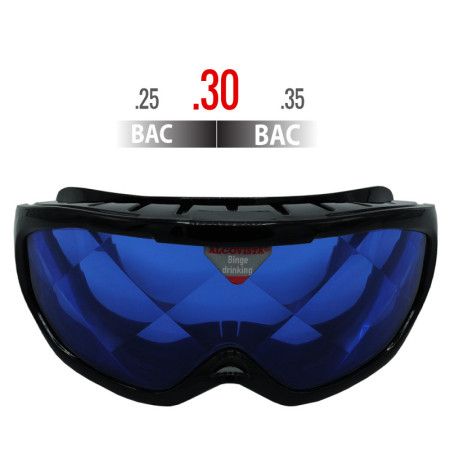


Binge drinking impairment goggles , BAC .2,5 - .3,5 "totaly wasted"
VERY HIGH LEVEL. "BINGE DRINKING IMPAIRMENT"
Impairment Simulation of approximately .25 to .35 BAC, more or less 8 to 10 cups of alcoholic beverage.
DAYLIGHT and NIGHLIGHT vision, Blue lens.
Average .30 BAC
Main effects of ALCOVISTA ® impairment goggles:
- Very high Problems of balance
- Very poor appreciation of distances
- Significant visual disturbances
- Narrowing the field of view (tunnel effect)
- Slowing reflexes
- Quadruple vision
With each goggle included 1 microfiber bag and 1 microfiber lens cleaner.
Customer service
Public authorities
5-year guarantee
shipping by UPS
|


Understanding Binge Drinking: Definitions and Issues
Definition and Terminology
The English term ‘binge drinking’ is translated into French as ‘Alcoolisation Ponctuelle Importante’ (API). It is also known by the following terms:
-
Acute alcohol intoxication.
-
Massive alcohol consumption.
This behaviour is defined as seeking intoxication within a very short period of time. In France, according to the OFDT, API corresponds to the consumption on a single occasion of:
-
6 standard glasses or more in adults.
-
5 standard glasses or more for adolescents.
Characteristics of behaviour under the influence of ‘binge drinking’
Binge drinking is not continuous consumption, but an episodic and intentional practice:
-
Seeking intoxication: A planned activity, often taking place in a group or in public places.
-
Frequency: Behaviour that generally recurs 1 to 2 times a month, or even more frequently.
-
Intermittency: The shift from total sobriety to heavy drinking.
Current Situation and Trends (ESCAPAD Survey 2022)
Changes in behaviour among 17-year-olds between 2017 and 2022 reveal contrasting trends:
-
An overall decline: The use of psychoactive substances is falling.
-
Increased abstinence: 19.5% of adolescents have never drunk alcohol (an increase of 4 percentage points compared with 2017).
-
Social disparities: Young people in apprenticeships or who have left the school system show significantly higher levels of alcohol consumption than those still at sixth form.
Immediate Risks and Medical Complications
Occasional excessive consumption exposes users to immediate dangers:
-
Behavioural risks: Loss of control, impulsive or violent behaviour, road traffic accidents.
-
Medical emergencies: Alcoholic coma, respiratory problems, physical injuries and, in exceptional cases, death.
Short- and Long-Term Consequences
Alcohol has a profound and lasting impact on the brain:
-
In the short term: Brain and functional damage leading to cognitive deficits, notably memory problems (particularly evident amongst students).
-
In the long term: Structural damage to the brain.
-
Addiction and psychiatry: Early onset (before the age of 15) drastically increases the risk of addiction in adulthood and the onset of psychiatric disorders.
